
News
Check out our latest publications here: Publications
Study Published in Frontiers in Systems Biology
25th September 2025
We are excited to share the latest results of the study published last week on predictive biomarkers identified in an in-silico clinical trial of metastatic colorectal cancer patients. The work was an integral part of the PhD studies of ESR Juan Manuel García Illarramendi, who was hosted by Anaxomics and supervised by Dr. Judith Farrés Marisch on the beneficiary side and Prof. Dr. Xavier Daura from the Institute of Biotechnology and Biomedicine at the Universitat Autònoma de Barcelona (UAB) in Spain. To learn more, read the publication here.

New Publication in iScience
26th August 2025
The latest work from the Hausser lab (USTUTT) on PKD3 and late endosomes is now published! They show that PKD3 supports lysosomal homeostasis and Wnt signaling to drive breast cancer stem cell formation. Congratulations to Elena Gutiérrez Galindo on her first first-author research paper!

Höpfl et al. published in PLOS Computational Biology
15th May 2025
The paper titled “Integrated mathematical and experimental modeling uncovers enhanced EMT plasticity upon loss of the DLC1 tumor suppressor” was a joint effort by it’s co-first authors Sebastian Höpfl and Merih Özverin from the University of Stuttgart. Merih was hosted in the Olayioye lab for the duration of her PhD project work.
In the study, the team investigated the epithelial-mesenchymal transition (EMT), a crucial process for understanding tumor progression, metastasis, and drug resistance. EMT involves complex interactions at the RNA and protein levels, leading to significant changes in cell behavior.
The focus was on the role of the tumor suppressor protein Deleted in Liver Cancer 1 (DLC1) during EMT. Using breast cancer cells, they combined cellular assays with mathematical modeling to extend an existing EMT model to include DLC1. Our findings reveal that DLC1 acts as a positive regulator of EMT by promoting the expression of the transcription factor and EMT master regulator SNAIL1. When DLC1 is lost, progression of the process is impaired, and cells exhibit a partial EMT phenotype. Reversion from a completed EMT is typically impossible because cells express self-stimulatory growth factors in the mesenchymal state. Interestingly, the published model also suggests that losing DLC1 in mesenchymal cells could lead to a reversion to partial or epithelial states.
The work highlights the central role of DLC1 in cellular plasticity, underscoring its significance as a tumor suppressor. These findings contribute to a broader understanding of EMT and its implications for cancer research and treatment.

Celebrating the successful Doctoral Thesis Defense of Elena Gutiérrez Galindo
11th October 2024
Elena embarked on her doctoral project journey in the beginning of 2020, as one of 15 Early Stage Researcher of our doctoral training network focusing on uncovering the role of the secretory pathway in disease, specifically in cancer.
Elena’s project
The thesis was looking into the Protein Kinase D (PKD) family (comprising PKD1, PKD2 and PKD3), involved in various cellular processes including proliferation, protein transport, migration, secretion and stress response. An isoform-specific dysregulation of PKD expression has been found in different tumors, including breast cancer. While PKD1 and PKD2 are the main isoforms in normal tissue and non-invasive breast cancers, the PKD3 isoform is overexpressed in triple-negative breast cancer (TNBC), in which PKD1 is epigenetically silenced, suggesting isoform-specific functions. In particular, in TNBC PKD3 was shown to be necessary to maintain the stem cell population, as well as to support cell proliferation via preserving the integrity of the endolysosomal compartment.
Elena’s PhD work was uncovering the underlying mechanism regulating PKD3 function, including the discovery of a previously unrecognized role for PKD3 at the additional compartments of the secretory pathway, providing new insights into the isoform-specific functions of the PKD family in TNBC cells. Finally, her work also postulates a potential PKD3 substrate, in pursuit of a specific mechanism which could explain the observed PKD3- dependent effects on cellular secretion.
On the 11th of October, Elena defended her work in front of her colleagues and the thesis committee members, obtaining her degree with a “magna cum laude” distinction!
We are eagerly looking forward to the publication that will detail all her hard work!
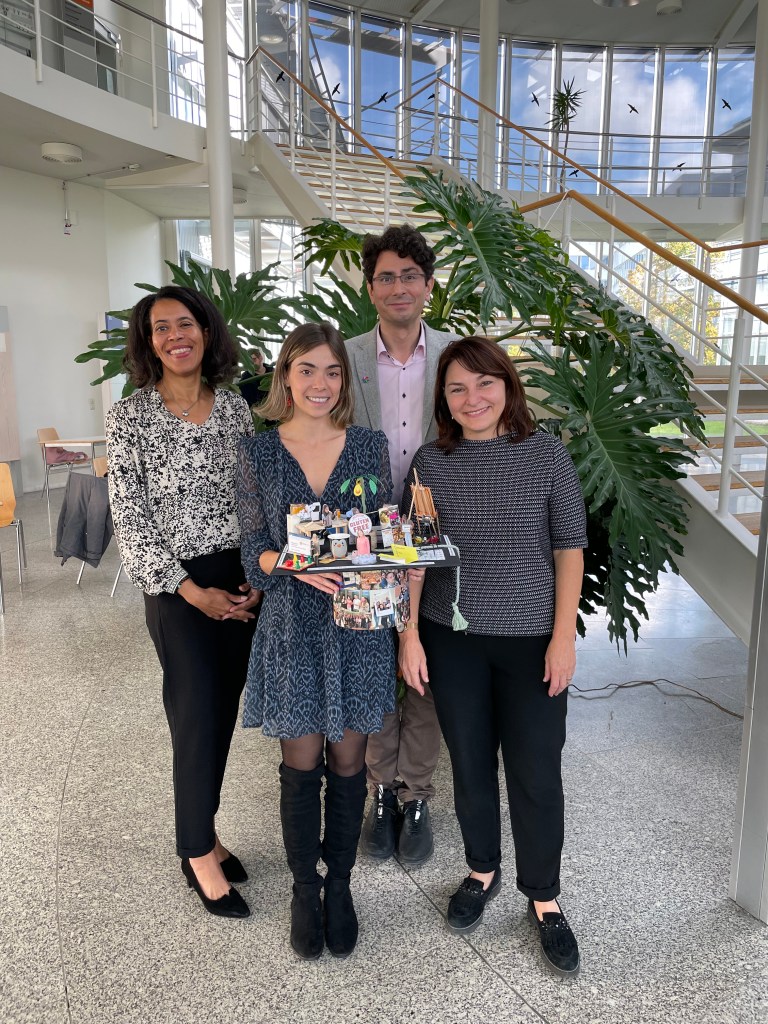
Jacqueline Bersano, hosted at private sector beneficiary Charles River Labratories, has defended her thesis
18th January 2024
Our warmest congratulations go to SECRET-ITN ESR Jacqueline Bersano for successfully defending her PhD thesis! Thanks to Dr. Julia Schüler’s valuable supervision at her host institution, Charles River Laboratories! Jacqueline was enrolled as a PhD student at the University of Freiburg, having Prof. Tilman Brummer (representing SECRET-ITN beneficiary UKLFR) as her academic PhD thesis supervisor. Part of her work has been published recently in the journal Cells and was focusing on the cytokine profiles of a subset of CRC cell lines and the influence of the cancer cell secretomes on invasion, EMT and angiogenesis.
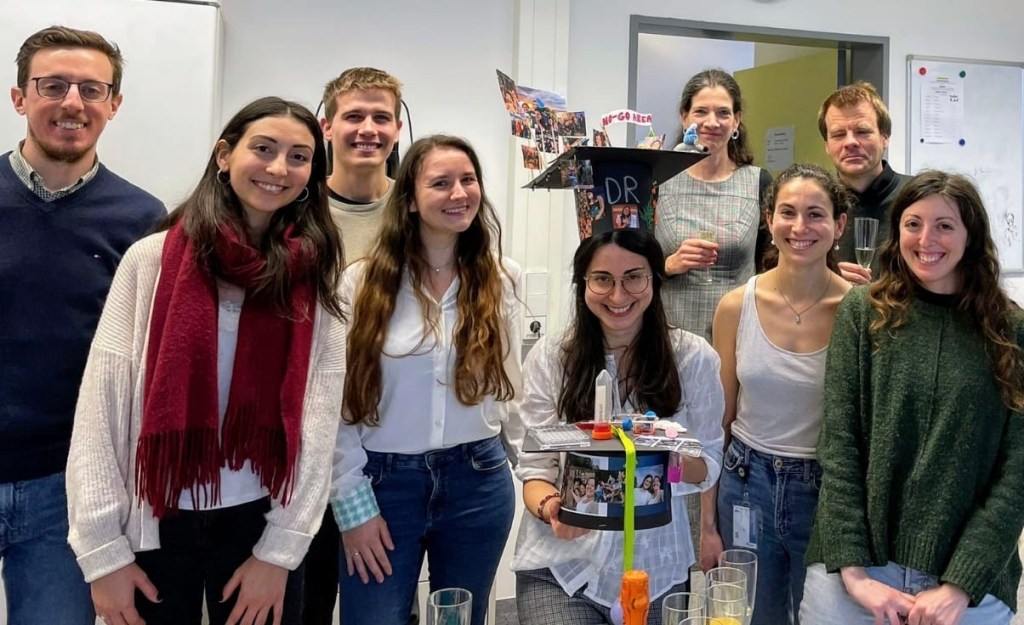
Thesis defense alert! Negar Parizadeh has successfully defended her PhD work
12th December 2023
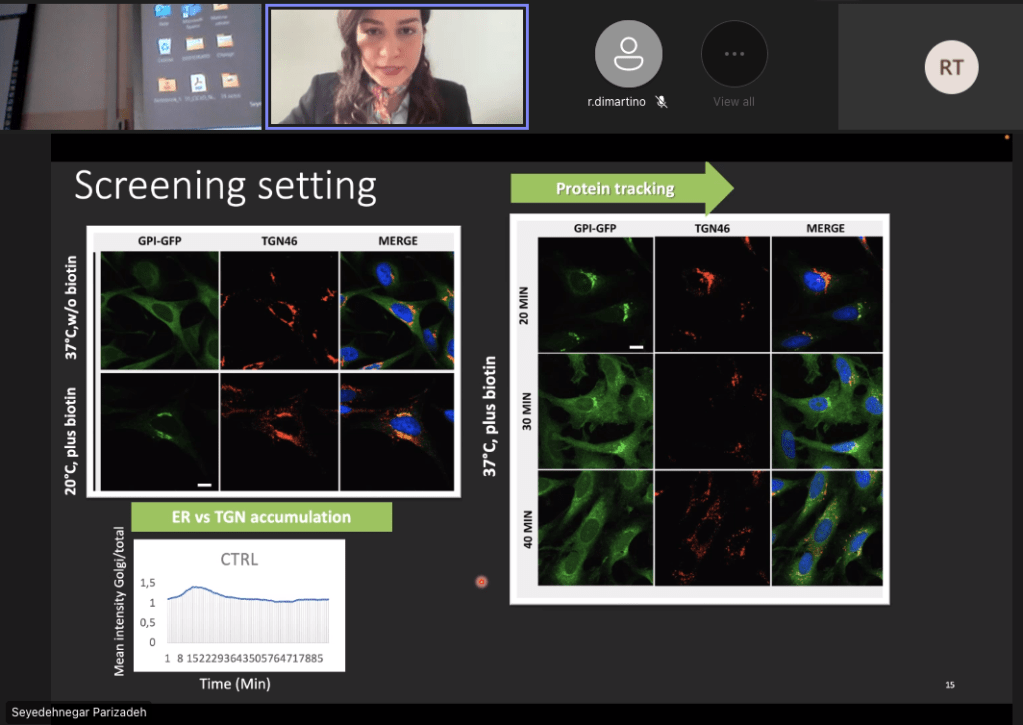
Negar, hosted at the National Research Council of Italy in Naples (CNR) and supervised by Prof Alberto Luini, was enrolled in the PhD Programme in Molecular Life Science at the partner organization University of Campania Luigi Vanvitelli and obtained her doctoral degree in December 2023. She was successful in defending her work on the interplay between the autoregulation of cargo export form the endoplasmic reticulum and the control of cell growth.
 SECRET ITN